


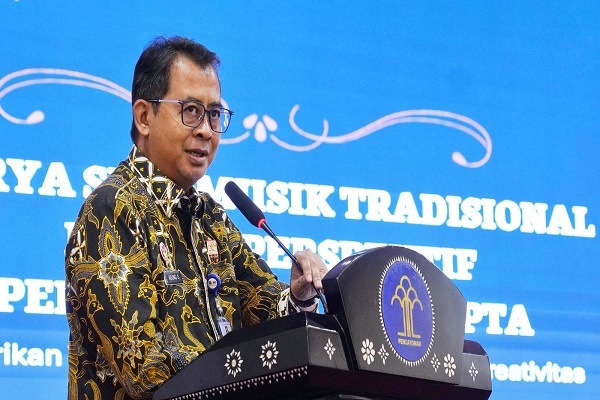
DJKI assures that the royalty payment scheme is not burdensome across all business actors. Specifically for micro, small, and medium enterprises (MSMEs), the government offers options for reduced or waived royalty fees based on the size of the business premises, visitor capacity, and the extent to which music is used in daily activities.
DJKI, under the Ministry of Law and Human Rights, firmly states that all forms of music playback in public spaces by business operators must be accompanied by royalty payments to the songwriters and copyright holders. This obligation applies without exception, including for those who already subscribe to digital music streaming services such as Spotify, YouTube Premium, Apple Music, or other platforms.
Agung Damar Sasongko, DJKI’s Director of Copyright and Industrial Design, explained that subscribing to a streaming service is not a valid legal basis for broadcasting music publicly in a commercial context.
“Streaming services are for personal use. When music is played to the public in a business space, it falls under commercial use, and therefore requires an additional license through a legitimate mechanism,” said Agung Damar Sasongko in an official statement on Wednesday (July 30, 2025).
The royalty payment mechanism is clearly regulated under Law No. 28 of 2014 on Copyright and Government Regulation No. 56 of 2021 on the Management of Song and/or Music Royalties. Payments are made through the National Collective Management Organization (LMKN), which is officially tasked with collecting and distributing royalties to songwriters and related rights holders.
Through this collective system, business operators no longer need to individually obtain permission from each songwriter, making the process more practical while still ensuring the protection of artists’ economic rights.
He also addressed concerns from some business owners who admitted to avoiding playing Indonesian songs to evade royalty payments. According to him, such behavior not only disadvantages the creators but also hampers the growth of national culture and the creative industry.
“Music is part of our cultural identity. When business operators are unwilling to provide proper appreciation to Indonesian songwriters, it’s not just the artists who suffer—consumers and the entire national creative ecosystem are affected as well,” Agung said.
Regarding the use of instrumental music or foreign songs claimed to be royalty-free, Agung reminded that not all music is free of copyright. He stated that some songs labeled as “no copyright” could still lead to violations if used without source verification.
“This includes foreign songs—if they are copyrighted, royalty obligations still apply,” he added.
For business operators without a budget for royalty payments, there are legal alternatives such as using royalty-free music, Creative Commons-licensed music that allows commercial use, playing their own compositions, using ambient sounds, or directly collaborating with independent musicians who grant permission free of charge.
To proceed with royalty payments, businesses can register through LMKN’s digital platform. The royalty amount is determined by business classification and the area where music is played. For example, a non-franchise restaurant with a capacity of 50 seats is charged around IDR 120,000 per seat annually, totaling IDR 6 million per year. For businesses calculated based on area, the fee is approximately IDR 720 per square meter per month.
DJKI assures that the royalty payment scheme is not uniformly burdensome. For MSMEs, the government provides options for reduced or waived royalties depending on space size, visitor capacity, and how extensively music is used in day-to-day operations.
“We urge MSME operators to formally apply for these exemptions to gain legal protection while also supporting the national music ecosystem,” he added.
Furthermore, Agung reminded that violating the royalty payment rules may result in legal sanctions, both administrative and civil lawsuits. However, under Article 95 (4) of the Copyright Law, any dispute must first be resolved through mediation.
Case of the Mie Gacoan Bali Director
This clarification was also delivered by DJKI in response to reports regarding one Mie Gacoan outlet in Bali, which allegedly had not paid royalties for music played in the business premises.
Previously, the Bali Regional Police officially named IGASI, Director of PT Mitra Bali Sukses—the franchise holder of Mie Gacoan in Bali—as a suspect in a case involving alleged copyright infringement for publicly playing songs without permission in his restaurant.
The suspect status followed a public report received by the Bali police on August 26, 2024. After an investigation, the case was escalated to the inquiry stage based on a police report dated January 20, 2025. In this case, the Indonesian Music License Center (SELMI), one of the authorized Collective Management Organizations (CMOs) in Indonesia, acted as the complainant.
The Head of Public Relations of the Bali Police, Police Commissioner Ariasandy, stated that the estimated losses in the case reached billions of rupiah. This amount represents the estimated royalty value that Mie Gacoan should have paid for commercial use of songs in its business premises.
The estimation was based on the Decree of the Minister of Law and Human Rights of the Republic of Indonesia No. HKI.2.OT.03.01-02 of 2016 concerning the royalty rates for commercial use of copyrighted works and/or related rights products in the restaurant sector. The formula used is: number of seats in an outlet multiplied by IDR 120,000, multiplied by one year, multiplied by the number of operating outlets.
“To date, investigation results show that full responsibility in this case lies with the director,” said Arisandi, as reported by Antara.
Source of the article : DJKI Emphasizes Public Music Playback Requires Royalty Payment